
April 2026 Quarterly Newsletter
Moving forward all quarterly newsletters and AGM notices will come from a variation of communications(number)@nchenz.org.nz for example communications1@nchenz.org.nz it is a good idea to register the address @nchenz.org.nz as a safe sender as all contact from us comes from variations of this address.
Contents:
Visit the private members-only area of our website
BOOKMARK THIS LINK!
You can only access this section of the website through this members only link, so it is best to bookmark it for future access.
Programs and Discounts for Term 2 2026
New year, New name, We have renamed our Members Offers to Programs and Discounts to help reduce the confusion between Members Offers and memberships also so the name better describes itself for new people joining NCHENZ.
Access discounts that are usually reserved for schools, available only to our members.
LITERACY PLANET
Starts 2nd May
For students aged 4-15 (Years 0-10). A comprehensive online literacy program with thousands of interactive activities across multiple strands. The program covers key literacy areas, inspiring a love of learning through engaging storytelling, while building strong foundational literacy skills and supporting each student’s individual growth.
For more info & to enrol: https://www.nchenz.org.nz/literacyplanet
CODE AVENGERS
Starts 20 April
For ages 5+. Code Avengers lessons are designed to simplify abstract programming concepts and help students apply what they learn through projects, games, and real-world applications. As students progress, they can move on to programming languages, learning important skills for the future.
For more info & to enrol: https://www.nchenz.org.nz/code-avengers
KIDS DISCOVER ONLINE
STARTS 22ND APRIL
For ages 6-14yrs approx. Different subject areas within the science and social studies spheres, helping your student learn how to research and draw cross-curricular comparisons, as well as some very interesting key topics! Limited spaces - First in basis upon payment received.
For more info and to enrol: https://www.nchenz.org.nz/kids-discover-online
When programmes are due for renewal Gin will email you from that programmes email address while all the emails are different they all end with @nchenz.org.nz so it is best to save this as a safe sender to ensure your emails don't get sent to spam.
OPT in to a Monthly Email to your Inbox
Information about Programs and Discounts is now only posted on the private, members only Facebook group and in our monthly notices email. If you are not a member of the Programs & Discounts Facebook group, we highly recommend you subscribe to our monthly notices email. All members receive this quarterly update, however the monthly email is OPT-IN only. Email memberships@nchenz.org.nz or click this link and send.
Otherwise, keep up-to-date in our three private members-only Facebook groups: Our general one; Navigating Through Highschool & Beyond; and Programs & Discounts

Homeschooling Wins
Daniel Silsbee is a homeschool graduate (fully homeschooled through high school and actually homeschool uni, too), and Ruby Webb is a current homeschooled high school student. Both won trophy awards from Diving Waikato. Daniel – 2025 most improved diver of the year and Ruby – 2025 diver of the year. Daniel is currently the New Zealand champion in his age category 19-25. Ruby won 3 golds in her first competition. Both have risen as cream to the top of the team and the sport in just a couple years of competing (Daniel 3, Ruby 1+). They are representing Diving NZ in Australia age-based competitions in April, plus representing Waikato Diving at the North Island comps in Wellington and NZ National comps in Christchurch later this year.

In the News
The homeschool ride to parliament featured in Alice Soper's NZ Herald round-up of women in sport for 2025 - Alice Soper putting School Sport NZ on her naughty list for 2025 for denying inclusion of all students in sport after Amelia rode to parliament.
Amelia has been in the local news with her most recent cycling adventure - cycling Tour Aotearoa - a bike packing event that starts at Cape Reinga and finishes in Bluff.
We love hearing about your homeschooling wins and the kids love to see their photo in our newsletter. Big or small wins, they all count to us. Email details and a photos to info@nchenz.org.nz to be included in the next quarterly newsletter.
2026 Home Education Survey
The survey is closed and the results have been collated.
Thank you to everyone who took part in the 2026 Survey. We genuinely appreciate all the support and feedback that came with the surveys. Please know we read every comment and we will act on your suggestions as and when it’s appropriate.
Local Group Engagement Facilitator
At NCHENZ we want to build a closer relationship’s with Local homeschool groups so we have created a new role we named:
Local Groups Engagement Facilitator localgroups@nchenz.org.nz
This role is all about building stronger two-way communication between local groups and the national team. This role was created because we genuinely want to hear from you. We know every group is different, and your experiences and needs are important in shaping what we do together.
We would like to start with the basics. Is your group listed on our support groups page? Please have a look here and see if your group is listed (if it is; are your details correct?) and if its not please send the details to localgroups@nchenz.org.nz Group name, contact details, if it is a Facebook group a link is appreciated.
If you have feedback you want to share, information you want to see, things you want us to provide, please let us know, we want to help.
Update from the Government Liaison Team
Government Liaison Report
By Cynthia Hancox, Government Liaison
Home Education Statistics:
I recently received from the Ministry and ERO a range of statistics on home education. Key statistics are:
As of 31 st December 2025, there were 11,501 exempt students, from 6,818 families.
Auckland has the largest number of exempt students in total (2,493) with the biggest group being in Auckland North/West (1,312). Central & East Auckland has 481 exempt students, and Auckland South has 698.
Canterbury has the second largest cohort of home educators (1,581 students from 901 families), and Waikato the third largest (1,274 students from 759 families).
Four other regions each have between 1,010 and 1,069 students each – these are: Northland, Bay of Plenty/Rotorua/Taupo, Taranaki/Whanganui/Manawatu and Nelson/Marlborough/West Coast.
Remaining regions are: Wellington (782), Otago/Southland (771) an Hawkes Bay/Gisborne (471).
In 2025, the Ministry received 2,372 exemption applications. Of those, 1,977 were approved (83.3%), 105 were declined (4.4%), and the remainder were still pending at the end of the year.
In 2025, 1,205 students ceased home education.
Between 2015 and 2023, ERO reviewed an average of 7 students per year. In 2024 and 2025, they reviewed 106 and 111 students respectively.
I have requested further data, particularly around ERO review outcomes and subsequent actions.
Review of Home Education Policy, Regulations and Monitoring:
The Minister of Education, Erica Stanford, has indicated that home education “regulations” are being reviewed, with an intention to “strengthen monitoring.”
We have been attempting to arrange a meeting with the Minister, but without success so far. I have had an email from the Senior Policy Manager at the Ministry’s National Office, to whom the Minister’s office passed my request from November last year, stating that “This work is still in development, and we are not in a position to discuss this with you at this time. We would welcome the opportunity to meet with you later in the year to hear your perspectives and feedback once our work is further developed.”
I am continuing to seek further information and meetings, as I believe it is backwards (though not uncommon) for the Ministry to decide among themselves matters about an issue (in this case, home education) of which the majority staff involved know very little, if anything, at all. While they may not be able to answer our questions at this time, I believe they would benefit from information we may be able to offer so that their considerations are made from a better-informed position.
Regardless of what unfolds, its seems very likely that home educators will in the future be subject to greater scrutiny than we have for the past 17 years, and it would be wise for all families to be giving consideration to how they are recording their children’s learning and progress, and what evidence they could show ERO or the Ministry if asked, as well as regularly reflecting upon their learning programme and their children’s changing needs, and what, if any, improvements they could make.
We should be doing these things anyway – but it is very natural for people who have never been called upon to show proof to just let them slide, as there are always other more urgent matters to attend to.
Please understand that a review is a serious matter. On the basis of a finding by ERO that your child is not being taught either as regularly and/or as well as, the law allows the Ministry of Education to revoke the exemption certificate and require the child to be enrolled in school within 14 days, with no right of appeal.
Obviously, that position is extremely inequitable – no school would be subject to immediate closure on the basis of one “failed” review – a fact that we continue to put across whenever we can.
In the past, ERO reviews of home educators have generally been conducted in a way that is reasonably fair. However, I currently have no confidence that we can trust this to be the case. ERO recently completed over 100 reviews of home educators that were conducted in a manner that was anything but reasonable or fair, representing a significant breach of trust. Work around that is on- going but I have concerns about how it may translate to future reviews of the wider home education community.
NCHENZ’s Government Liaison team will continue to advocate for the community. Whatever unfolds, it is not going to happen overnight. No one should panic at this stage, however, while there is nothing to panic about is the best time to start to “up our game” while there is space and time to do so.
I’ve been in the home education space for 30 years, and have seen government and Ministry policies come and go. One thing I can say for sure – it is home educators of the past who by and large positioned themselves well to show evidence of their children’s learning programme and give thoughtful responses to questions by ERO that led to the relaxing of previous expectations of routine review of home educators, because over 95% of then-home educators had positive review outcomes. Let’s make sure we are again well positioned to demonstrate that our children are also being taught at least as regularly and well as…should we be called upon to do so.
NCHENZ has information about ERO reviews and preparing for them on the website here: https://www.nchenz.org.nz/being-reviewed
School Trials - Term 1 Ministry Mistakes
Since 2015, there has been a policy in place whereby home educated students can enrol in a school for up to 10 school weeks, and within that time return to home education without needing a new exemption application. Until recently, the Ministry did not proactively inform families of the trial period when they enrolled a student in school. This term, however, the Ministry decided that they would do so, a positive thing. However, because this was done by the Resourcing team, who are less familiar with general home education policy, there have been some mistakes made in communications, with families told, in some cases, the wrong start dates for the trial period, or given wrong information about how long the trial lasts and how their allowance is affected.
Here are the correct facts:
If a student was enrolled in a school from the first gazetted day of the school year (Jan 26 th this year) then their enrolment date is backdated to 1 st January, and therefore their exemption ceased from December 31 st.
If they enrolled at any later date, then backdating does NOT apply.
School holidays do not count as part of the school trial period. You have up to 10 school weeks for a trial.
Upon return to home education, if you notify the Ministry within the 10 week period, exemptions can be reinstated without the need for a new application, in most cases.
The exemption and therefore the supervision allowance eligibility, is ceased from the first day of enrolment. If the student is enrolled in school for less than 28 days before returning to home education, then you are entitled to the allowance for the entire period for them. If enrolled for more than 28 days, then returned to home education, the entitlement is on a pro-rata basis for the period in which the exemption is in force.
If you were given the wrong information by the Ministry, and have had any issues around returning to homeschooling, please get in touch for support. You can email govt.liaison@nchenz.org.nz.
Attendance Services issues
Most of you reading this newsletter will already have your exemptions and have no expectation of interactions with attendance services. However, some of you may be in the process of transitioning a child to home education, or talk with new families who are.
In January 2026, new attendance services contracts came into effect. This means in many, if not most, parts of the country entirely new companies and new staff are contracted to deliver attendance services. Training for those services has been limited, and as a result, staff in some regions are applying what they think is expected of them in ways that are problematic for home educators. I have written to the Ministry manager responsible for overseeing attendance services and expect to meet with them soon to discuss the issues that have arisen.
Meanwhile, if you have an exemption application being processed by the Ministry and are contacted by Attendance Services, let them know that is the case. They can follow up with the Ministry on the progress of your application.
If you have not yet submitted your application, and are contacted by Attendance Services, let them know when you expect to submit it by, and do get it completed as soon as you can. They should be willing to give you reasonable space to do this.
What attendance services should not do: ask you to explain your reasons for homeschooling, tell you that “most applications are unsuccessful so you need a Plan B” (the stats above disprove that!), tell you that you should give them the exemption application to review or submit, or that they will “help” you with the application (they don’t have the knowledge), or say that they have to continue to follow up with you after the exemption has been approved.
If you have any difficulties or questions, email me at govt.liaison@nchenz.org.nz.
2026 Elections and Party Policies on Home Education
I will be contacting each of the political parties running in this year’s elections and asking them about their policies or intentions in respect of home education, and their responses will be published in our next quarterly newsletter. Be sure to look out for that in our October newsletter!
Homeschooling Resource: Fire Safety
Looking for a practical, family-friendly way to teach your children about fire safety? Get Firewise, developed by Fire and Emergency New Zealand, is a free programme designed to help children in Years 1 and 2 understand what to do in a fire emergency and it -also works well in a home learning environment.
Get Firewise uses a simple, engaging approach that fits naturally into everyday homeschooling routines. Through stories, hands on activities, role-play, and real-life scenarios, children learn what a fire emergency looks like and how to respond safely and confidently. Rather than abstract lessons, they practise real skills such as recognising the sound of a smoke alarm, staying low in smoke, and knowing exactly where to go if they need to get out fast.-
Benefits for Families and Home Educators
One of the biggest benefits of Get Firewise is its flexibility, activities can be explored at your own pace, adapted for different ages, and enjoyed together as a whānau. Creating a home escape plan becomes a meaningful family project, and acting out “Get Down, Get Low, Get Out - FAST” helps turn an important safety message into a memorable moment. These practical experiences help children feel prepared rather than scared, giving them clear steps to follow in an emergency.
Teaching fire safety at home also strengthens children’s real world decision-making, builds their confidence, and helps them understand how to keep themselves and others safe. For parents, the programme provides an easy, guided way to have safety conversations that might otherwise feel hard to start.-
Resources for Parents & Homeschool Groups
All programme resources are available online, including videos, printable activities, and parent guidance. Explore them here:
https://www.fireandemergency.nz/teachers-and-schools/get-firewise/
Ordering a Get Firewise kit provides access to educator quality resources, including a teacher guide and 30 homework books with sticker sets. While the kits aren’t available in smaller quantities, homeschool groups or -learning coops often share a kit across multiple families. The materials are durable, easy to use, and designed for repeated activities and discussions.
A Lifelong Safety Skill set
Using Get Firewise at home doesn’t just support your curriculum, it gives your children lifelong safety skills. Learning together as a family helps children understand how to stay calm, make good decisions, and take action to keep themselves and others safe if a fire occurs.
And remember: If you discover a fire, get out, stay out, and call 111 immediately. Never try to fight a fire yourself.

Business Spotlight: Grace Notes Piano NZ
Our family has homeschooled for all our schooling, starting with our oldest doing kindy at home, now married and studying counselling at uni. The most challenging years were when we had students in all levels of primary, intermediate and high school at the same time. Our youngest is in homeschool high school now, and I am looking forward to retiring from my 25+ year homeschool journey in a couple years. However, I don’t suspect it will be the end as two of our three are currently entrepreneurs, and I still do a lot of business coaching with them, including marketing, health and safety, bookkeeping and taxes, etc. with both of them.
I earned my university degree in music, with a proficiency in piano, and I chose not to study teaching as part of that journey. I didn’t want to be a bad piano teacher, so I decided I wouldn’t study piano teaching. However, teaching has chosen me, as I have always had people asking me to teach them how to play piano after they heard me play.
I was passionate about home educating my children, and I did study all about that including how they learn, different learning styles, curriculum types, and anything I could read or listen to on the topic of homeschooling well. Every time I had a baby, I gave up my piano students, but the piano students always came knocking on my door. Each time my child was old enough to cope with me teaching piano, I would take a few students again.
All three of my children wanted to learn piano because they saw other young people coming to learn and having fun. None of my three chose to continue to advanced stages with piano, and ultimately each chose another instrument (voice, banjo, and accordion/recorder). In fact, of the three, each child went farther than their older sibling on their piano lessons with me. This was not because the last child was more gifted in music but rather because I was continually becoming a better teacher. When I began teaching again after our youngest was old enough, I found I actually had become passionate about teaching piano, quite the turnaround from my young self. I credit this to our homeschool journey opening my eyes to how each individual person is different, learns differently, and processes differently, benefiting without cookie cutter expectations put on them.
In 2019 I was accepted into the Institute of Registered Music Teachers of New Zealand, and I am currently serving on the Waikato Branch committee as secretary and treasurer as well as mentoring incoming teachers. This year I hired a graduate piano student from my studio (also homeschooled) to begin investing in the next generation of piano teachers. With a well-established and respected studio, I am open to more such arrangements like this around New Zealand as support and mentoring with professional development is an important part of success.
In our studios we have a large number of students across a wide range of ages. Since COVID there has been a noticeable uptake of adult piano students. Although I teach from my home south of Hamilton, I have some distance online adult students in multiple locations and as far away as Whangarei.
We are also now offering small group piano lessons for young students, which is a very fun way to begin learning.
In our studios, students learn both how to read music, play off lead sheets, how to improvise (‘play by ear’), theory, perform and accompany at church or school, and take music exams if they want to, but most importantly enjoy their lessons and their home practice. I’m always telling students that they teach me, too. It’s a lovely reciprocal journey.
For those who might be interested to discuss in-person lessons or online lessons, the student application form will give some additional information.
Lori Silsbee
Collaborative Pianist
Piano Teacher
Mentor for New Piano Teachers
Rukuhia, Hamilton, NEW ZEALAND
Hillary Outdoors
What if your next adventure was right on your doorstep?
We’re excited to introduce NavQuest Rogaines! A fun, flexible outdoor navigation challenge designed for everyone. Whether you're looking for a family day out, an outdoor challenge for your students, or just keen to explore somewhere new, this is your invitation to get outside and give it a go.
Grab your course map, plan your route, and set off to collect as many checkpoints as you can within 70–90 minutes. Each checkpoint has a different score, and there’s no set path, it’s all about strategy, teamwork, and making the most of your time.
Walk it, jog it, or cruise at your own pace. Go solo or bring your crew. It’s your adventure.
Perfect for:
A whānau day out
Training sessions
Mates & social groups
Solo missions
Schools & sports teams
Anyone curious to try something new
No experience needed Just a sense of curiosity and a willingness to explore.
A small fee, a big impact
Entry is just $15 per person – less than a movie ticket, and it unlocks a full outdoor adventure you can enjoy on your own schedule. Even better, every registration helps support the Hillary Step Scholarship, giving young people the chance to access the outdoors and experience the confidence, connection and growth that comes with it.
So, while you’re out exploring, you’re also helping someone else take their first step into adventure!
Want something a bit more involved? Try Discovery camps.
Coromandel Discovery Camp
6-13th June 2026
23-30th January 2027
Tongariro Discovery Camp
25 July-1st August 2026
We’re also running a Wanau Programme - a unique opportunity for a parent, caregiver, or guardian to share the Hillary Outdoors experience alongside their teen (ages 11–18). The camps help strengthen relationships through shared adventure, teamwork, and personal discovery.
Coromandel Whanau Programme
12-17th July 2026
Tongariro Whanau Programme
25 Sept-2nd Oct 2026
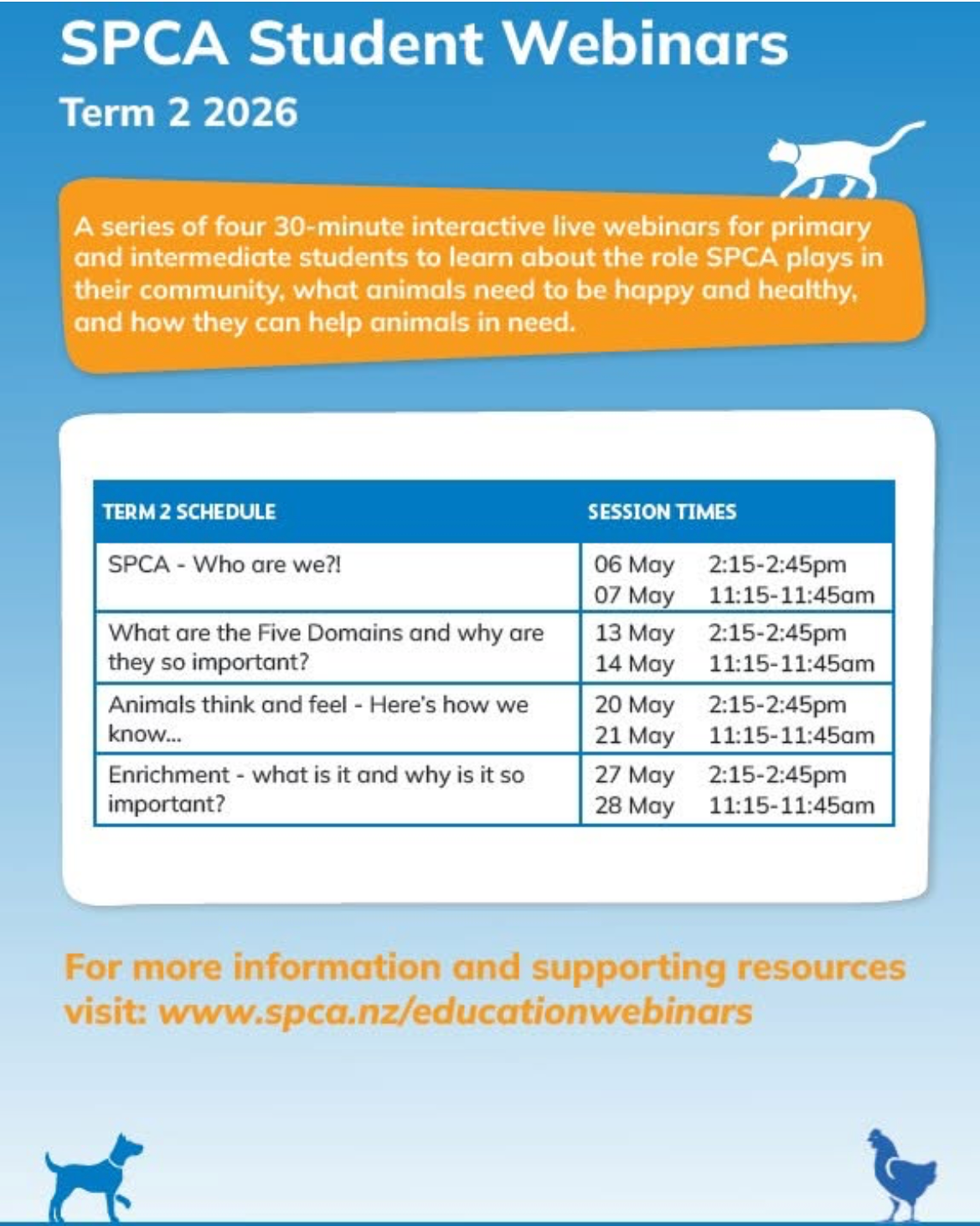
SPCA’s new Dog Safety resources - on our Kids’ Portal
These engaging, age-appropriate resources help children learn how to recognise and interpret dog body language and signals. Most dogs show clear signs of stress well before a bite occurs, and by learning to identify these cues and risky situations, children and adults can help prevent unsafe interactions. The Dog Safety resources introduce basic dog communication and teach calm, appropriate responses that reduce the risk of bites and support safer, more positive interactions for both people and dogs.
Through these resources, children will learn how to:
Respond if an unknown dog approaches them
Safely meet and interact with dogs
Understand that dogs have feelings too
Build positive, respectful relationships with dogs
Together, these lessons equip children with practical, easy-to-remember safety rules, while also developing empathy and kindness towards dogs—helping them enjoy safe, positive experiences and minimise the risk of unsafe interactions.
You can view the resources here: Kids’ Portal – Dog Safety
Donations
Membership to NCHENZ is free and has been for many years so that the organisation is available to every NZ home educator - but we do rely on donations to keep the [virtual] lights on. If you are in a position to make a donation to NCHENZ please consider doing so. We suggest $25/family for the year, but you may pay more or less (or nothing at all), your membership will continue regardless.
Our account details are: Kiwibank 38-9014-0162108-00 Account name: National Council of Home Educators New Zealand
Include Reference: “donation” and if you wish you can include your last name and NCHENZ membership number

About NCHENZ
The National Council of Home Educators NZ (NCHENZ) has been an Incorporated Society since 1998, dedicated to supporting and advancing home education across Aotearoa NZ at a national level.
We are the nationwide homeschooling body in NZ representing all home educators, and we hold a strong commitment to neutrality. As per our Constitution, we do not endorse or promote any particular political, religious, educational, parenting, or socio-economic philosophy or methodology. Our focus is on creating an inclusive environment where all members, regardless of their cultural background or beliefs, feel welcomed and respected.
We have had zero membership fees for many years to ensure that the organisation is accessible to the entire homeschooling community, regardless of personal circumstances.
Email us on info@nchenz.org.nz